



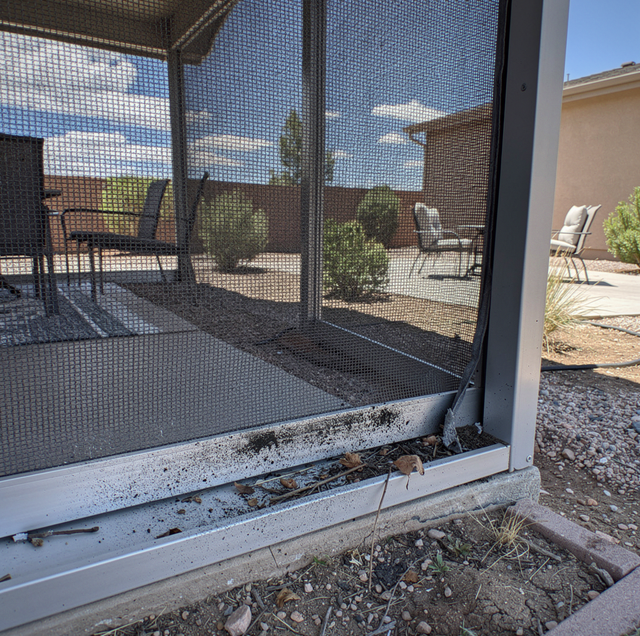
You notice it on a morning walk around the enclosure: fine black speckling across the mesh, worse near the corners and along the shaded side, the kind of dirt that doesn't wipe off with a dry hand. That's rarely ordinary dust or pollen buildup. It's mildew, growing directly on the screen fibers and the vinyl coating that holds them together, and it spreads faster than most homeowners expect once it takes hold. The instinct is to blast it off with whatever's fastest: a hose on full pressure or a scrub brush and a splash of bleach. Both can leave the enclosure looking worse than the mildew did, and neither explains why the growth appeared in the first place.
Why Screen Enclosures Grow Mildew in the First Place
Mildew is a surface fungus, and it needs three things to establish itself: moisture, organic material to feed on, and shade to keep that moisture from evaporating quickly. A screen enclosure provides all three with little help from you. Rain and dew settle into the weave of the mesh and along the bottom track of the frame, and unlike a solid wall, a screen doesn't shed water quickly because its entire surface is textured to catch airflow rather than repel liquid. Pollen, dust, and tree debris collect in that same texture, giving mold spores something to feed on once moisture is present.
Shaded sections of an enclosure are the most reliable spot to find it. A north-facing panel, a stretch under a roof overhang, or an area screened in close to trees holds humidity longer than a panel that gets a few hours of direct sun each day, because sunlight and airflow are what dry mesh out between rain events. Panels that stay damp for a day or two after a storm, rather than drying within a few hours, are the ones that develop the fine black or gray speckling first. Once a colony establishes on the mesh coating, it spreads along the weave, much like mildew spreading across a damp shower curtain, following the surface rather than staying contained to one spot.
What Happens When You Clean Mildew the Wrong Way
The two most common cleaning mistakes come from treating screen mesh like a driveway or a vinyl fence, both surfaces that hold up fine under force. Screen mesh doesn't.
Pressure washing at full strength: A pressure washer set anywhere near the PSI used on concrete or siding will punch straight through screen mesh, stretching individual strands past their limit or tearing the weave open entirely. Even where it doesn't tear the mesh outright, high-pressure water forces its way behind the spline, the thin cord that locks screen into the frame channel, and can push it loose enough that the panel starts sagging within weeks. Mesh that's already spent a few seasons in direct sun is more brittle than new screen, so the same pressure that a fresh panel might survive can shred an older one on the first pass.
Abrasive scrubbing: A stiff-bristled brush or an abrasive pad breaks down the vinyl coating that gives fiberglass screen its structure, leaving fuzzy, weakened fibers where the coating used to be. That damage isn't always visible right after cleaning, but it shows up months later as small tears that start at exactly the spots that got scrubbed hardest. Mildew stains often sit slightly below the surface of the coating rather than on top of it, which is why scrubbing harder feels productive in the moment, even as it removes material the screen needs to stay intact.
Bleach at the wrong concentration: Bleach kills mildew effectively, but full-strength bleach applied directly to mesh degrades the same vinyl coating that abrasive scrubbing damages, just chemically instead of physically. Left on too long or rinsed too little, it also drips onto aluminum framing and hardware, where repeated exposure speeds up corrosion at screws, hinges, and track fittings. The fix isn't avoiding bleach altogether; it's using it diluted, applying it briefly, and rinsing it completely before it has a chance to sit and work on anything other than the mildew itself.
Cleaning Solutions That Are Actually Safe for Screen Mesh
A mild solution does the job that force is supposed to do, without the side effects. A dilute mix of bleach and water, roughly one part bleach to ten parts water, is enough to break down mildew on contact without concentrating on the coating long enough to weaken it. Plain dish soap and warm water handle lighter buildup on its own, especially on panels caught early before the mildew has had a full season to establish. Commercial mildew removers formulated for vinyl and fabric work as well, provided the label doesn't call for a stiff brush or a hard rinse to activate.
What to avoid regardless of which cleaner you choose: ammonia-based cleaners mixed with bleach, which produce a dangerous reaction; any cleaner marketed for concrete or masonry, since those are formulated for a completely different surface; and anything applied with a stiff brush, sponge with a scouring side, or steel wool, none of which belong anywhere near screen mesh.
A Safer Step-by-Step Cleaning Approach
1. Rinse first with a garden hose, using normal household water pressure rather than a pressure washer, to knock loose surface dust and pollen before any cleaner touches the mesh.
2. Mix a diluted cleaning solution in a bucket rather than spraying concentrate directly, so you control how strong the mix is before it ever reaches the screen.
3. Apply with a soft cloth, sponge, or soft-bristle brush, using gentle, even pressure along the direction of the weave rather than scrubbing in circles.
4. Let the solution sit for a short period, typically a few minutes, giving it time to break down the mildew before you rinse, rather than trying to scrub it out immediately.
5. Rinse thoroughly with the garden hose, working from the top of each panel down, until no cleaning solution or loosened mildew residue remains on the mesh or dripping onto the frame below.
6. Let the enclosure air-dry fully before touching the mesh again, since damp screen is more fragile and more prone to fingerprint-shaped tears from casual contact.
Working one panel at a time, rather than soaking the entire enclosure at once, keeps the cleaner from sitting too long on any single section while you move on to the next.
Cleaning Frames and Hardware Without Causing New Damage
The aluminum frame and hardware need a gentler touch than most people assume, too, just for different reasons than the mesh. A soft brush and the same diluted solution used on the screen will lift mildew and grime from the frame without scratching the finish. Abrasive pads and metal brushes leave fine scratches in aluminum that trap moisture and accelerate corrosion at exactly the spots you just cleaned, turning a cosmetic fix into a maintenance problem down the line.
Hardware deserves extra attention around hinges, tracks, and screws, since standing moisture in those spots after cleaning is what drives corrosion more than the mildew ever did. Wiping hardware dry after rinsing, rather than letting it air-dry, reduces standing water that promotes mildew regrowth and rust.
When Mildew Staining Means the Mesh Needs Replacing, Not Just Cleaning
Cleaning restores mesh that's stained on the surface. It doesn't restore mesh that's been structurally compromised, and telling the two apart matters before you spend an afternoon scrubbing a panel that needed replacing anyway.
A few signs point to replacement rather than another cleaning pass. If the mildew stain remains as a gray or black shadow after a full cleaning cycle, rather than lifting away, the fungus has likely worked into the coating itself rather than sitting on top of it, and no amount of additional scrubbing will pull it back out without damaging the mesh further. If the screen feels brittle or chalky to the touch, or if light pressure with a finger produces a small tear or a puff of fine fibers, UV exposure has already broken down the material to the point where mildew is a symptom of an aging screen rather than the cause. Mesh in that condition often develops a new tear within days of a thorough cleaning, simply because the cleaning process, gentle as it is, is enough stress to finish off fibers that were already close to failing.
A useful test is to gently press a fingernail against a stained section after it's dry. Mesh that flexes and springs back is usually salvageable with cleaning. Mesh that crumbles, tears, or leaves a permanent dent is past the point where cleaning solves anything, and continuing to treat it as a cleaning problem just delays a rescreen that's already needed.
How Often to Clean to Keep Mildew From Coming Back
Mildew doesn't take long to reestablish once conditions favor it, so a single deep clean rarely solves the problem for good. A light rinse every few weeks, focused on the shaded and low-airflow sections that stay damp longest, keeps spores from building up enough to take hold. A full cleaning with a mild solution once or twice a year, timed before the wettest stretch of the season and again afterward, handles the growth that a quick rinse alone won't remove.
Trimming back overhanging branches and vegetation that shade a panel or block airflow across it addresses part of the root cause directly, since less shade and better air movement mean the mesh dries faster after every rain. Enclosures with better airflow throughout the structure tend to require far less mildew cleaning overall, simply because the surface doesn't stay wet long enough for spores to settle and multiply.
Frequently Asked Questions
Is mildew on screen mesh actually harmful, or just unsightly?
It's both. Beyond its appearance, mildew growing directly on the coating that holds the fiberglass mesh together gradually breaks that coating down, and the same organic buildup traps moisture against the screen longer than clean mesh would, which also speeds up brittleness from sun exposure.
Can I use vinegar instead of bleach to remove mildew from mesh?
A diluted vinegar solution can lift light surface mildew and is gentler on mesh coating and hardware finishes than bleach. It's usually less effective on established or deep-set staining, so it works best as a light-maintenance option rather than a fix for heavy growth.
Why does mildew keep coming back on the same panels?
Mildew returns fastest on panels that stay shaded and damp the longest after rain, since those conditions rarely change between cleanings. Cleaning removes the existing growth but doesn't change the airflow or shade pattern that let it establish there in the first place.
Will a pressure washer damage screen mesh even on a low setting?
It can. Even at a lower setting, the water concentrates into a narrow stream that exerts more force per square inch than a garden hose, and that force can still stretch the weave or drive water behind the spline holding the screen in the frame channel. A wide fan pattern at household water pressure is a safer substitute.
How long should a cleaning solution sit on mildew before rinsing?
A few minutes is usually enough for a mild diluted solution to break down surface mildew without giving it time to work on the vinyl coating underneath. Longer dwell times don't clean much better and increase the chance of coating damage, especially with stronger mixes.
Does mildew on the mesh mean the frame has mold too?
Not necessarily. Frames and mesh can host mildew independently, since aluminum framing doesn't feed mold growth the way the organic coating on mesh does. A frame usually shows mildew as a surface film that wipes away easily, while mesh holds it more stubbornly within the weave itself.
Schedule a mesh and frame inspection before another season of mildew leaves you needing more than a cleaning — a quick look tells you whether your screen still has life left in it. Lanai Guy serves Brandon, Riverview, and the greater Tampa area. Call (813) 316-5971.