
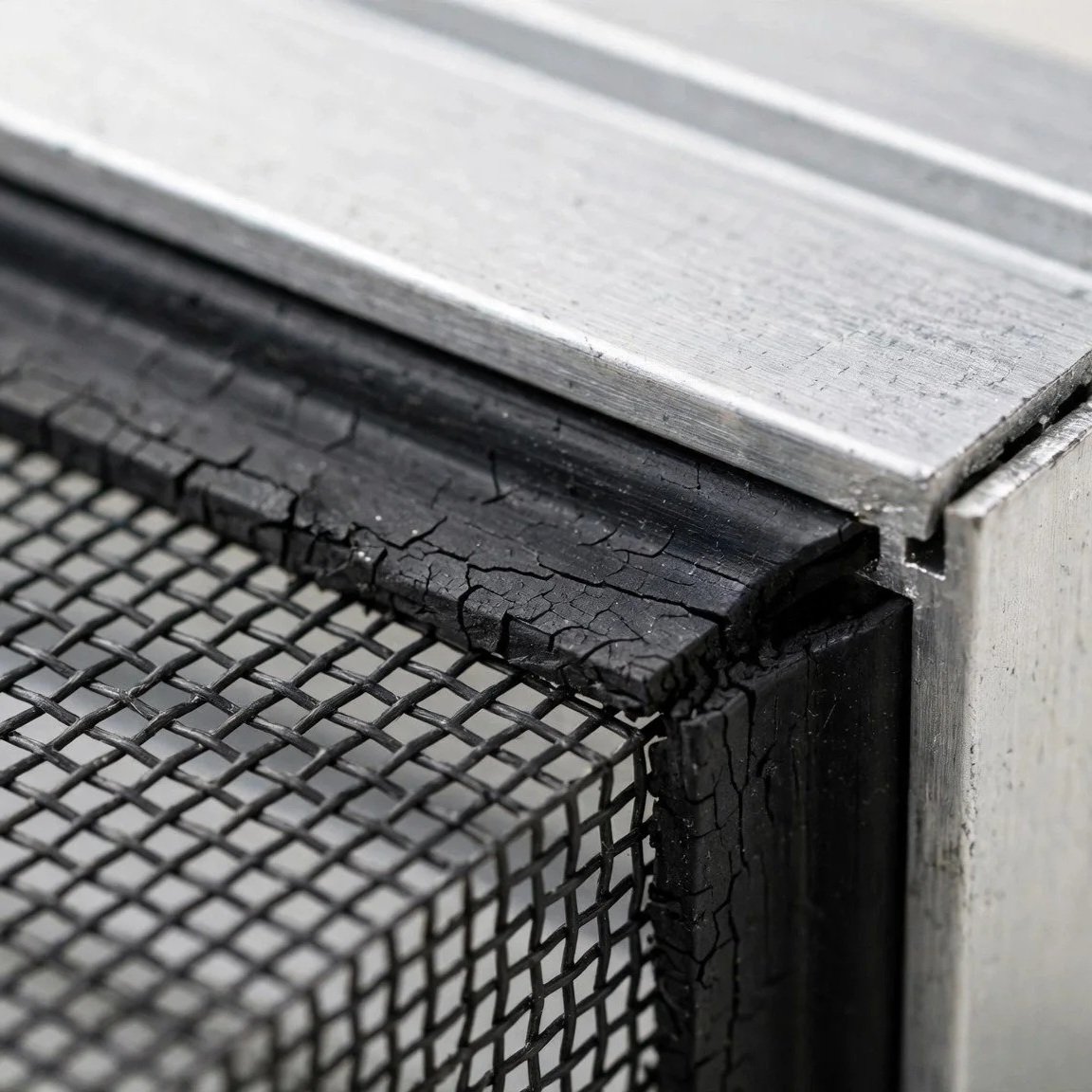
Run your finger along the channel at the edge of a screen panel, and you will feel a thin cord pressed into the groove. That cord is the spline, and it is doing all the quiet work of holding your mesh tight in the frame. When it fails, the screen it was gripping starts to sag, billow, and eventually pull free, and homeowners often blame the mesh when the real culprit is that dried-out strip of vinyl. Understanding why splines harden and crack tells you what you are actually looking at when a panel goes loose, and whether you are facing a small fix or a bigger one.
What Spline Actually Does in the Frame
A spline is the flexible vinyl or rubber cord that gets pressed into a channel called the spline groove, which runs around the inside edge of each aluminum frame member. When a screen is installed, the mesh is laid over the opening, and the spline is rolled down into the groove on top of it, pinching the mesh against the channel walls. That pinch is the only thing holding the screen. There are no staples or adhesive doing the real work; the tension in the mesh and the spline's friction in the groove are what keep a panel drum-tight. So the spline's health is not a detail. It is the mechanism.
Why the Vinyl Hardens and Cracks
Spline is a plastic, and like most plastics left outdoors, it breaks down under ultraviolet light and heat. UV degradation attacks the polymer, and the constant heating and cooling cycle drives out the plasticizers that keep the cord pliable. As those soften-and-flex agents leave, the spline hardens, shrinks slightly in diameter, and turns brittle. You end up with a cord that used to be springy and is now closer to a dried-out rubber band that snaps rather than stretches.
A shrunken, stiff cord no longer presses firmly against the walls of the groove, so its grip weakens even before it visibly breaks. And brittle vinyl cracks and flakes; once a section splits, that stretch of the screen has nothing holding it up. The mesh loosens, sags, and in a gust of wind, it billows and can pop clean out of the frame. What looks like a screen problem is usually a spline problem that reached its end first.
Not all splines age at the same rate. The thin, cheaper cord has less material to give up before it fails, and the spline, which was the wrong diameter for the groove to begin with, never gripped well, so it works loose sooner. The sun does the rest.
Why Some Sides Fail Long Before Others
Walk a screen enclosure, and you will often find one or two sides where the spline is cracked and flaking while the rest looks fine. That is not random. UV exposure and surface heat drive the breakdown, so the panels that bake in afternoon light take more total UV over the years than a shaded side and dry out first. This is why re-splining is frequently a partial job rather than all-or-nothing: the failure follows the sun.
Spotting a Failing Spline Before the Screen Blows Out
You can usually catch this by looking rather than waiting for a panel to let go. The clearest sign is the spline itself: run a fingertip along the groove and look for a cord that is hard, cracked, or shedding small flakes of vinyl rather than feeling soft. A screen that has started pulling out of the channel at a corner is another giveaway, since corners are where tension concentrates, and a weak spline releases first. Sagging mesh, or a panel that ripples and billows when the wind hits it, means the spline has already lost part of its grip. Catching it at the flaking stage rather than the blown-out stage is the difference between rolling in fresh spline and chasing a screen across the yard.
Re-Splining One Panel Versus a Full Rescreen
When a spline fails, you have two honest options, and which one fits depends on how far the aging has spread.
Re-splining means pulling the old spline out of the groove, re-tensioning the mesh, and rolling in a new spline, panel by panel. This is the right call when only a section has failed, the sunny side, say, while the mesh across the rest of the enclosure is still sound. If the screen itself is in good shape and only the cord has let go, you can often reuse the same mesh and simply re-secure it with a new spline.
A full rescreen replaces the mesh and the spline together. That is the better value once the spline is brittle everywhere, because the spline and mesh live under the same sun and tend to reach the end together. When the cord is cracking on every side, the mesh is usually just as sun-tired and thin, and re-splining panel after panel only postpones a rescreen you will end up doing anyway. The judgment call is whether the failure is local or everywhere, and whether the mesh has life left once the spline is renewed.
Matching Spline to the Groove
One detail decides whether a re-spline holds: diameter. Spline is sold in a range of sizes, and the cord has to match the width of the groove with the mesh folded in. Too small and it will not pinch the screen firmly, so the panel works loose and pops out again in short order. Too large and it will not seat fully, or it forces the mesh so hard that it can tear at the edge. The right size compresses snugly into the groove and stays put. If you are redoing a panel yourself, measure the existing spline or the channel and match it rather than guessing, because a mismatched cord is one of the most common reasons a fresh re-spline fails early.
What It Comes Down To
Dried-out, cracked spline is not a defect in your screen so much as the predictable end of a plastic cord that has spent years in the sun. Because the spline is what actually holds the mesh, its condition is worth checking before you assume a loose or sagging panel means a whole new screen. Sometimes it is a partial re-spline on the sunny side; sometimes the cord is telling you the mesh is done too. Either way, the flaking strip in the groove is the first thing to read, and it usually tells you most of what you need to know.
Frequently Asked Questions
How can I tell whether it is the spline or the frame making my screen sag?
Press gently on the sagging mesh near a corner. If the screen has pulled out of the channel or the spline is cracked and loose, the spline is the cause, and re-tensioning fixes it. If the spline is intact and seated but the whole panel looks out of square, or the aluminum member is bowed or bent, the frame has flexed, often from a past impact or a settling structure, and that is a framing repair, not a re-spline. A quick tell: spline failure is usually confined to one or two edges, while frame trouble throws the whole panel off shape.
Does a higher-quality or UV-resistant spline actually last longer?
It generally holds up better than bargain cord, yes. A denser, thicker spline simply has more material to lose before it goes brittle, and some vinyl is compounded with UV stabilizers meant to slow its breakdown. Manufacturers market certain lines as UV-resistant, and while that is a reasonable claim rather than a guarantee, the practical gain is real: better cord tends to stay pliable longer under the same sun. It is worth pairing a quality spline with a quality mesh, since replacing one with the other leaves the old one a false economy.
How long does screen spline usually last in strong sun?
There is no fixed number, but under intense year-round UV, the spline commonly starts hardening and losing grip somewhere between several years and about a decade, often reaching the shorter end on the sun-blasted sides. Shaded panels can go noticeably longer. Because the exposure is uneven, it is normal for one enclosure to have a spline that is failing on the west and south faces while the north side is still soft, which is why age alone is a poor predictor, and inspection beats guessing.
Can I reuse the old mesh if only the spline failed?
Often, yes, if the mesh is still strong. Tug a corner of the screen: if it feels firm and does not tear or powder, it likely has life left, and re-splining will re-tension it fine. But sun-tired mesh gives itself away by feeling stiff, looking chalky, or splitting when you pull the old spline out. If the mesh tears as you re-tension it, that panel wants a full rescreen, not a re-spline, and forcing old mesh back in only means redoing it soon.
What goes wrong when people try to re-spline it themselves?
The two common mistakes are over-stretching and using the wrong tool. Pulling the mesh too tight before rolling the spline puts a permanent strain on it and can distort the panel or leave it puckered; the goal is snug and flat, not stretched to the limit. The other is using the wrong roller. A convex-wheel spline roller seats the cord into the groove, and a separate concave or knife wheel is meant for trimming excess mesh, so using one for the other job either fails to seat the spline or slices the screen. A dull utility blade to trim the overhang, run along the outside of the spline, finishes it cleanly.
Why does the screen keep popping back out even after I re-spline it?
Almost always a size mismatch. If the new spline is a hair too small for that groove, it will not pinch the mesh hard enough, and the panel releases again, usually at a corner first. Pull a short length back out and compare it to the groove width with the mesh folded in; step up one size if it seats loosely. The other cause is a groove that has been widened or nicked by years of prying, in which case a slightly larger spline takes up the slack. Rolling the spline in two passes rather than forcing it in one also helps it seat evenly and stay put.
Have a screen pulling loose or a spline that is cracking on the sunny side? — Get a free on-site estimate on re-splining or a full rescreen. Lanai Guy serves Brandon, Riverview, and the greater Tampa area. Call (813) 316-5971.