



Rescreen vs Rebuild: What Does Your Pool Cage Actually Need?
You walk out to the pool, look up at the cage, and something is clearly wrong. Maybe a panel is flapping in the breeze, maybe the mesh sags like a hammock, maybe a whole section looks like it shifted after the last storm. The question every homeowner lands on is the same: do you just need a new screen, or does the whole thing need to come apart and go back together? Those are two very different jobs, and the real answer depends on what is actually failing, not on how bad it looks from the deck. Understanding which part fails first tells you which repair you are really buying.
What Rescreening Actually Fixes
A rescreen deals with the screen, and only the screen. The aluminum frame, the beams, the uprights, and the anchors all stay exactly where they are. What gets replaced is the woven mesh stretched across each opening and, in almost every case, the spline that holds it in place.
This is the right call when the frame is still doing its job. If your posts are straight, the corners are square, and the structure does not move when you lean on it, but the screen itself is torn, baggy, discolored, or pulling away at the edges, you have a screen problem. The mesh has simply reached the end of its life. Sun and UV break down the fibers over years of exposure, so the material that started out taut and tight becomes brittle, thins, and finally splits or sags. That is normal wear, not a sign the cage is coming down.
Rescreening is the most common service a pool cage ever needs, and for good reason. The frame is built to outlast several sets of screens if the hardware is looked after. So when only the woven part has failed, replacing it panel by panel restores the enclosure without touching the structure that is still sound.
When a Rebuild Is the Real Answer
A rebuild, whether it is the full cage or just one damaged section, is a structural repair. Here, the problem is not the mesh. It is the aluminum, the fasteners, or the anchors that hold the whole assembly to your deck.
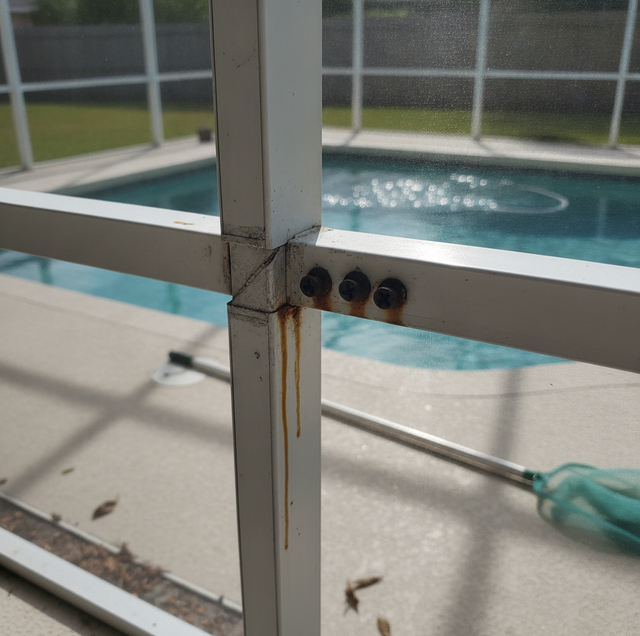
The clearest signs are physical. A frame that wobbles or flexes when you push on it has lost rigidity somewhere. Rust streaks bleeding down from screw heads tell you the hardware is corroding. Aluminum members that are bent, cracked, or visibly separating at a joint are no longer carrying load the way they should. Anchors that have lifted off the footer or deck mean the cage is no longer properly tied down. Any one of these is a structural issue, and no amount of new screen will fix it.
Storm damage is the other common trigger. High wind can rack a cage, pushing the frame out of square so the once-rectangular openings become leaning parallelograms. A racked section has to be re-squared and re-anchored before it will hold screen again, which is rebuild work, not rescreen work.
Here is the part many homeowners miss: the aluminum is often the last thing to fail. The fasteners usually go first.
The Detail Most People Overlook: Fasteners Fail First
Think of the frame as a stack of strong bones held together by small joints. The bones and the aluminum resist corrosion well and can look perfectly straight for years. The joints, the screws, are the weak point. In a humid, salt-tinged climate, the screws rust before the aluminum shows any wear at all, and once a screw corrodes, it stops gripping. The joint loosens, the panel it was holding begins to shift, and the cage develops play even though every beam still looks arrow-straight.
This is why a cage can pass the eye test and still be failing. You look up, the aluminum looks fine, so you assume a simple rescreen will do. But if you press on a corner and feel movement, or you see rust weeping from the screw heads, the fasteners are already going. Catch it there, and the fix can be modest: replace the corroded hardware, re-anchor what has loosened, and rescreen. Ignore it, and the loosened joints let the structure work against itself until members bend and a real rebuild becomes the only option.
The Middle Ground Between the Two
Rescreen and rebuild are not the only two choices. A large share of pool cage work lands in between, and that middle ground often saves the most.
If the frame is fundamentally sound but the hardware has started to give, the repair is to re-screw and re-anchor the affected joints, swap out the rusted fasteners for fresh ones, and rescreen at the same time, since the screen is usually tired anyway. This is more than a rescreen but well short of a rebuild. It restores rigidity by fixing the joints rather than replacing the aluminum, and it heads off the slow slide toward structural failure.
Localized damage fits here, too. When one panel or one section takes a hit, from a fallen branch, a storm, or an impact, that single area can usually be re-squared, re-anchored, and rescreened as a partial rebuild. The rest of the enclosure, which is still sound, stays up. A cage rarely needs to come down in full for damage that is confined to one spot.
A Side-by-Side Look
The quickest way to sort your situation is to match what you see against what it means.
| What's Failing | Frame Condition | The Fix | Best For |
|---|---|---|---|
| Torn, baggy, or sun-rotted mesh; crumbling spline | Solid, square, no movement; screws hold | Rescreen (new mesh and spline) | A frame that has outlasted its screen |
| Rusted screws, minor joint play, panels shifting | Aluminum is straight, but the joints are loosening | Re-screw, re-anchor, replace hardware, rescreen | Catching fastener failure before the frame bends |
| One racked or storm-hit section | Localized bend or separation | Partial rebuild (re-square, re-anchor, rescreen) | Damage confined to a single area |
| Widespread bent aluminum, failed anchors, whole-cage wobble | Structure compromised in multiple places | Full rebuild | A cage that has lost its structural integrity |
Reading Your Own Cage Before You Call
You can do a basic assessment from the ground. Push firmly on an upright and watch for flex or wobble; a sound frame barely moves. Scan the screw heads for rust streaks running down the aluminum. Look at the beams and corners for anything bent, kinked, or pulling apart at a joint. Check where the cage meets the deck for anchors that have lifted. And run a hand along the spline, if it is dry and crumbles at a touch, that alone points to a rescreen.
The pattern is simple once you know it. Screen and spline problems mean rescreen. Frame and fastener problems mean repair or rebuild. Sort which side of that line you are on, and you know roughly what you are dealing with before anyone climbs a ladder.
That last point matters for safety. Inspecting from the deck is fine, but getting up on a ladder to work on a cage is where people get hurt, and anchor or structural work is not a homeowner's job. Fasteners at height, loads under tension, and connections that tie the whole enclosure to your deck all require someone who works safely and understands how the structure carries its loads. Reading the signs is yours to do; the repair itself, especially anything structural, belongs with a pro.
Two Stressors, Not One
It helps to remember that a pool cage lives under constant, mixed pressure. The sun and UV work slowly on the screen, drying the fibers and the spline until the mesh gives out; that is the stress that drives most rescreens. Wind and storms work suddenly on the frame, racking sections and shearing loose corroded fasteners; that is the stress that drives most rebuilds. Neither one is seasonal. Both act on the enclosure across the whole year, which is exactly why a cage tends to need the screen replaced more often than the structure, and why keeping the hardware from rusting is what lets the aluminum last through several sets of screens.
Frequently Asked Questions
How do I know if I only need a rescreen?
Press on the aluminum frame and look closely at it. If the frame is solid and square, the screws still hold firm, but the mesh is torn or baggy, and the rubber spline crumbles the moment you touch it, then only the screen needs replacing. Fiberglass screen commonly lasts on the order of five to seven years before UV embrittles it, while the aluminum frame lasts decades as long as the fasteners stay sound, so it is normal to rescreen a frame that still has plenty of life left.
What's the first structural part to fail on a pool cage?
Usually, the fasteners. The screws rust before the aluminum does, and once they corrode, they lose their grip, letting the joints loosen, and the panels shift while the frame members still look straight. Because the screw metal fails before the metal it holds, upgrading from coated or zinc screws to stainless-steel fasteners is what most effectively extends frame life, since it removes the part that was going to give out first.
Can one damaged panel be rebuilt without redoing the whole cage?
Often yes. A single racked or storm-damaged section can be re-squared, re-anchored, and rescreened on its own as a partial rebuild, so the whole enclosure rarely has to come down for localized frame damage. The sound sections stay standing while just the affected area is brought back to square and re-covered.
Why does the screen wear out faster than the frame?
The mesh is a woven fiber, and sun and UV slowly make those fibers brittle, so after years of exposure, the screen tears and sags, while the aluminum outlasts it as long as the hardware is kept from rusting. Mesh choice changes how fast that happens: a heavier weave, like a pet-resistant screen or a 20-by-20 no-see-um mesh, resists abrasion and wear differently than the standard 18-by-14 mesh, so what you specify affects how long a panel holds up.
What are the signs that the frame, not the screen, is the problem?
A cage that wobbles when you push on it, rust streaks running down from the screw heads, aluminum that is bent or pulling apart at a beam, and anchors lifting off the deck footer all point to structure rather than screen. When the fix is a partial rebuild, the new section gets tied back to sound members at the shared corner post, which is the load-transfer point a repair crew checks first before deciding how much has to come apart.
Does spline matter, or is it just the mesh?
The spline is the rubber cord that wedges the screen down into the frame channel, and it does real work. When it dries out and shrinks, the screen pulls loose from the frame even if the mesh itself is still intact. That is why a proper rescreen replaces the spline along with the mesh rather than reusing the old, brittle cord, which would only cause the fresh screen to sag again.
Book a free on-site assessment before you decide between rescreen and rebuild — get the right fix the first time. Lanai Guy serves Brandon, Riverview, and the greater Tampa area. Call (813) 316-5971 for an estimate.