



Pet-Resistant Screen: Is the Tougher Mesh Worth It?
If your enclosure has a dog that leans on the lower panels or a cat that treats the mesh like a climbing wall, you already know how fast standard screen gives out. Pet-resistant screen exists for exactly that problem. It is a heavier, tougher mesh, usually woven from thick polyester strands or vinyl-coated fibers, built to shrug off the claws, teeth, and body weight that shred ordinary fiberglass or aluminum screen. Before you decide whether to spend on it, it helps to understand what actually makes it different and where that difference matters.
QUICK ANSWER: Pet-resistant screen is a thicker, tighter-woven mesh (often marketed as 7x-stronger polyester) that resists tearing from claws and pushing. It is worth installing in the lower panels and door zones that take the abuse, while standard screen stays fine higher up. It trades a little visibility and airflow for durability, and it is not indestructible.
What Pet-Resistant Screen Actually Is
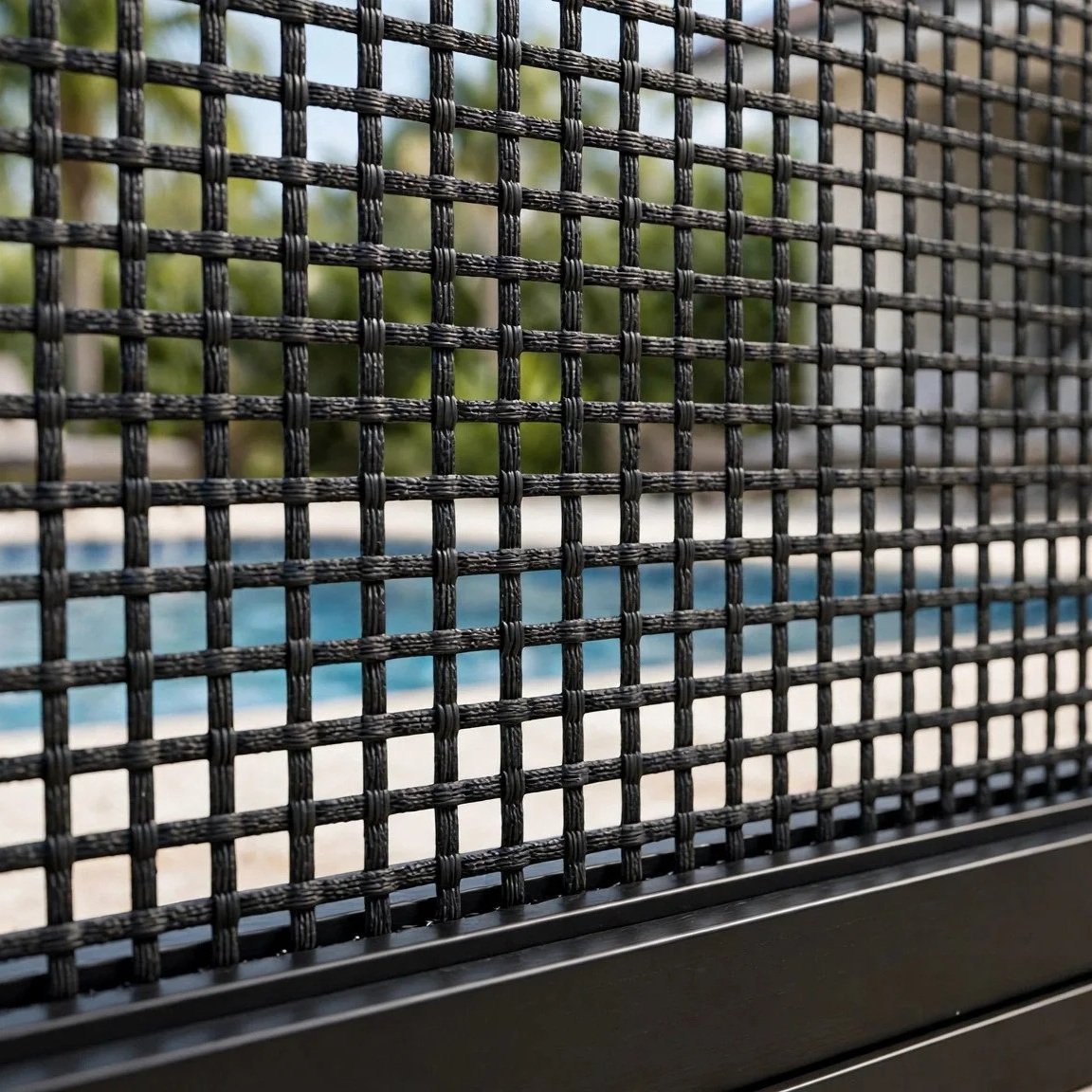
Standard screen for a pool cage or lanai is thin. Fiberglass mesh is a fine woven yarn coated in vinyl, and aluminum screen is a light metal wire. Both are engineered to be nearly invisible and to move air freely. Neither is engineered to survive a claw hooking into it.
Pet-resistant screen swaps that thin yarn for a much heavier strand. Most versions use a thick polyester fiber coated in vinyl, woven tighter than a standard mesh. The strand diameter is several times that of ordinary fiberglass, and the weave is denser, so there is less open space for a claw to hook and pull. Manufacturers commonly market these products as roughly seven times stronger than conventional insect screen. Treat that figure as a marketing claim rather than a lab constant, but the underlying point holds: the material is built to a different spec than the mesh already in your cage.
The result feels almost like a light fabric. Where standard mesh flexes and snags, pet screen resists the initial puncture and spreads the load across the tighter weave instead of letting one strand fail and run.
Why Standard Screen Fails With Pets
Ordinary screen does not usually fail all at once. It fails at a single point, then unravels from there. A few patterns show up again and again.
Claws snag and tear: A dog pawing at the mesh or a cat batting at a lizard on the other side catches one strand. That strand breaks, the surrounding weave loosens, and a small nick becomes a run within a few weeks.
Dogs lean and push at the bottom: Larger dogs rest against the lower panels or push their nose into the mesh to track a squirrel. Standard screen has almost no resistance to that steady horizontal pressure, so it bows, pops the spline out of the frame channel, or splits along the bottom rail.
Cats climb: A cat treats vertical mesh like a scratching post and gets a surprising distance up before the strands give. That concentrated weight and grip is the fastest way to open a hole high on a panel.
The common thread is that the damage lives low and near doors, right where pets make contact, while the mesh up high, out of reach, tends to stay intact for years.
How the Tougher Mesh Holds Up
Pet screen answers each of those failure modes with the same three properties.
Thicker strand: A heavier fiber simply takes more force to sever. A claw that would slice standard yarn tends to slide off or fail to break through.
Tighter weave: Denser spacing gives fewer gaps to hook into and distributes a push across more strands, so no single point carries the whole load.
More tear resistance: Even when the surface is nicked, the vinyl-coated polyester resists the run that turns a pinhole into a gaping tear in ordinary mesh.
Think of the difference the way a canvas tarp handles a snag compared to a paper bag: both can be cut, but one resists the tear spreading and the other splits from the first nick. That is the practical gap between pet screen and standard mesh in the zones that get abused.
The Tradeoffs You Should Know
Pet screen is not a free upgrade, and it is honest to name what you give up.
It costs more: The heavier material and denser weave carry a higher material price than standard fiberglass, and because it is stiffer to work with, installation takes more care. You are paying more per panel.
It reduces visibility and airflow slightly: A thicker strand and tighter weave block a bit more light and view, and they let a little less breeze through. Most people stop noticing after a day, but side by side against clear standard mesh, the difference is visible.
It is not indestructible: A determined animal, a sharp tooth working the same spot, or a heavy impact can still open a pet screen. It raises the bar substantially, but it is a tougher mesh, not armor. Anyone selling it as claw-proof is overselling it.
Weighed against constant repatching of standard mesh in the same lower panels, many pet owners find the durability pays for the tradeoffs. If your pets never touch the screen, you may not need it at all.
Where to Use It, and Where Not To
The smartest approach is rarely to rescreen the whole cage in pet mesh. It is to put the tough material only where the abuse happens.
Lower panels and the kick-plate area: The bottom two to three feet of any panel a pet can reach is the high-wear zone. Pet screen here absorbs the leaning, pawing, and nose-pushing that destroys standard mesh.
Door zones: Screen doors take the worst of it because pets learn to paw at them to be let through. The panels flanking a door and the door insert itself are prime candidates for the tougher mesh.
Standard screen higher up: Above pet-reach height, ordinary mesh is the better choice. It is cheaper, clearer, and breathes better, and nothing up there is clawing at it. Mixing materials by height gives you durability where you need it and visibility where you do not.
TIP: Put the tough mesh only where the abuse happens. The bottom two to three feet of any reachable panel and the door zones take the leaning, pawing, and climbing, while standard screen higher up stays cheaper, clearer, and better breathing. Mixing materials by height gives durability where you need it and visibility where you do not.
This split also keeps the overall view and airflow of the enclosure closer to what a standard screen alone would give, since only the lower course is the denser mesh.
Alternatives to Pet Screen
Tougher mesh is one answer, not the only one. A few alternatives solve the lower-panel problem differently.
A metal kick plate or lower panel guard: A solid aluminum or mesh guard bolted across the bottom of a panel takes the contact instead of the screen. Pets meet the guard, not the mesh, and the screen above it stays clean. This is a strong pick where a dog leans hard.
Aluminum lower panels: Some owners replace the bottom course entirely with a solid aluminum panel, trading the view through the lower section for near-total durability. It reads as a knee wall around the base of the cage.
A heavier lower course: A privacy-grade vinyl-laminated screen, sometimes sold under trade names for the lower panels, adds rigidity and screening to the bottom section while resisting damage better than standard mesh. It is not a pet-specific product, but it holds up better than ordinary screen in a contact zone.
The right alternative depends on the pet. A cat that climbs is better answered by tougher mesh across the whole reachable height, while a big dog that only leans low is often solved by a kick plate alone.
Maintenance and Safety
Pet screen lasts longer, but it is not maintenance-free, and a few safety points matter more than the mesh itself.
Rinse the mesh with a garden hose and a soft brush, and clean gently. A high-pressure washer will tear screen, pet-rated or not, so keep the pressure setting off the panels. Check the spline in the frame channel a couple of times a year, since pets that push on a panel can work the spline loose even when the mesh survives.
WARNING: A screen enclosure is not a legal pool barrier and does not replace proper pool-safety fencing, and a pet screen is not an escape-proof barrier either, so do not rely on it to contain a pet unsupervised. Any panel work involving a ladder or reaching over the pool carries fall and drowning hazards and is best left to someone equipped for it.
Frequently Asked Questions
Does pet-resistant screen come in different grades?
Yes. Beyond the common polyester pet mesh, there are heavier tensioned-wire products and marine-grade vinyl-coated meshes rated for even higher abuse. The polyester grade suits most household dogs and cats, while a tensioned metal mesh is aimed at large, powerful animals that defeat the standard pet product.
Will pet screen stop no-see-ums and small insects?
Not necessarily. Pet mesh is defined by strand strength, not by hole size, and its openings are often similar to a standard 18-by-14 insect screen. If tiny biting insects are the concern, you need a fine "no-see-um" mesh, which is a separate specification, and the two goals sometimes require different panels rather than one product.
Can I install pet screen only on my existing screen door?
Yes, and it is a common single-panel upgrade. The door insert is a self-contained frame, so the old mesh can be splined out and the pet mesh splined in without touching the rest of the cage. Because doors flex as they swing, using the correct spline size for the thicker mesh matters more on a swinging door than on a fixed panel.
How does pet screen hold up to UV over time?
The vinyl coating on the polyester resists sun degradation, but no screen is immune. Constant ultraviolet exposure eventually stiffens and chalks any mesh. Pet screen typically outlasts standard fiberglass in the same spot because the thicker strand has more material to lose before it fails, though color fade can still show first.
Is the tighter weave a problem for water drainage during heavy rain?
Rarely. The denser weave sheds water fine on a vertical panel because gravity carries it off. The place to watch is a screen roof panel, where a tighter mesh can hold a thin film longer, so most installers keep the roof in standard mesh and reserve pet screen for the walls pets actually reach.
Does pet screen affect how a pool cage handles wind?
It can, slightly. A denser mesh catches marginally more wind load than open standard screen, which is one reason full-cage pet mesh is uncommon. Confining the tougher mesh to lower panels keeps the added wind loading minimal while still protecting the zone that pets damage.
Book an onsite estimate before your next claw-torn panel becomes a full rescreen — get the right mesh in the zones that take the abuse. The Lanai Guy serves Brandon, Riverview, and the greater Tampa area. Call (813) 316-5971.