



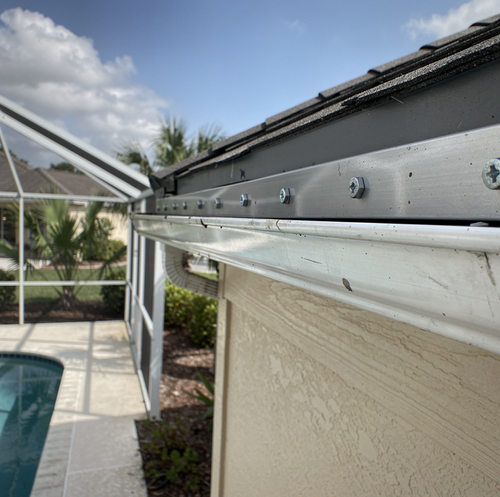
A roofing estimate and a screen enclosure estimate almost never mention each other. The roofer's scope ends at the drip edge and the fascia board. The screen company's scope begins at that same board, because the top rail of your pool cage is bolted through it and every post, purlin, and panel below hangs off that one line. Two trades, two schedules, one piece of aluminum between them. The tear-off date arrives, the crew leans ladders along a wall where the cage is still screened and still fastened to the fascia they need bare, and the work stops in your driveway while somebody makes a call. The order in which the two jobs run is determined in that call, and by then the choices have narrowed.
The Fascia Board Where the Two Trades Meet
Screen enclosures attach to the house along one horizontal member. On most pool cages, it is the integrated gutter, sometimes called a super gutter, an aluminum extrusion that holds up the cage roof and drains the panels above it. It is fastened through the fascia, or into a host beam behind it, with screws long enough to reach the rafter tails.
The question is simple: does that fastener line sit inside the roofer's work area? On a re-roof, it usually does. New edge metal goes on the fascia, the board underneath is often replaced with it, and the first course of shingles sits above the line your cage hangs from. Cages standing on posts a foot off your wall, or screen rooms bolted to masonry below the roof edge, come through untouched.
Who Takes the Cage Apart Before the Tear-Off Begins?
The screen company does, ahead of the roofer, on its own visit. A roofing crew carries no spline tools and no panel hardware, and taking your cage apart is screen work from the first fastener.
The detach runs in a fixed order, from the mesh inward. The screen in the bays along the house comes out first, which means the spline is rolled out of the channel and the mesh is lifted clear so nothing is trapped when the frame moves. The roof panels or the screen roof over that run come next, unscrewed from the purlins and slid out toward the deck. Only then do the fasteners through the top rail come out, and only after temporary posts are standing under the run, because the rail those bays hang from is the same rail that has been holding the house side of your cage plumb since it was built.
Sequencing it means three dates: the detach, the tear-off, and your re-hang. The detach wants to sit close to the tear-off, because an open cage collects weather and insects for as long as it stands open over your deck, and your crew cannot start putting it back until the roofer's edge metal is finished. Most screen companies hold a loose date and firm it up once the roof crew finishes.
Most of the Cage Never Leaves the Deck
A re-roof rarely means a full teardown. On most jobs, the disturbance is one run: the bays along the house wall, the panels over them, the gutter, and the fasteners through the top rail. The crew unbolts that line and lowers the gutter instead of taking your enclosure down as a unit, and the far posts, the door bay and the corner columns never move.
What stands has to stand safely with the rail off. The house-side posts lose their top tie when the rail comes out, so the crew braces them to the deck, usually with adjustable shoring screwed to base plates. The rest of your cage stays screened and tensioned, which is why the detach is kept to the smallest run that clears the roofer's work.
The Days the Roofers Are Working Over the Deck
With the rail down, the roofer has what he needs: a bare fascia, a clear eave to drop the tear-off past, and room to run drip edge and gutter apron continuously. It is also the point at which you lose the deck and pool to the work, since the shingle field above is being stripped.
Photograph the top rail before the first fastener comes out: the gutter pitch, fastener spacing, and each panel's position. A re-hang runs faster when that layout is on file.
The open bays change the space underneath. Wind-driven rain reaches the deck and the water, and the no-see-ums and love bugs the mesh was holding out have an open wall for as long as you are without a top rail. The frame is also more flexible in that plane without its top rail, so nothing gets leaned against it and nobody ties off to it.
Reinstalling to a Roof Edge That Has Changed
The edge your cage comes back to has changed while it was down. New drip edge sits proud of the old one, the fascia board itself is often new lumber, and the shingle overhang can land a quarter inch further out than it did. Where the old structural screws pulled out, their holes are enlarged and no longer line up with anything solid, so the crew moves the fastener line rather than re-using holes that will not hold.
The integrated gutter goes back first, and it goes back to a pitch. It has to fall toward its outlet along the full length of the run, and its back leg has to tuck under the new drip edge so that water leaving your shingles lands inside it, never behind it. The old sealant bed came off with the fascia board, so that joint is cut, cleaned, and re-sealed as new work.
Nothing is torqued down until your run is straight. The crew pulls a string line along the top rail and brings the house-side posts to plumb before the final pass on the fasteners, because a rail bolted back with a bow leaves every bay below it out of square, and a frame is easier to correct before the fasteners are tight. Panels go back in the bays they came from, since each was cut to its own opening.
Old Mesh Rarely Survives the Round Trip
Screen that has spent years in year-round UV rarely goes back in. The fibers stiffen and lose their stretch. The strip of mesh that sat compressed inside the spline channel is the weakest line in the panel, so the moment it is re-tensioned, it splits along that groove. Mesh in its first year or two survives the trip. Older mesh will not.
You make the practical move early: the rescreen is included in the roof job from the start. The panels are already out of the frame, the spline channel is open, and the crew that will re-hang your rail is on site. New mesh continues the work already underway, rather than arriving two months later as a second mobilization. A rescreen with the cage standing runs a different sequence, worked from inside it.
A Late Call on Sequence Adds Work to the Job
When the two schedules never meet, the roofer works around what you have standing. Edge metal stops short at the top rail and gets sealed against it, the last course of shingles is trimmed to the aluminum, and the fascia behind the rail stays whatever it was: old board, old fasteners, old sealant. The roof is finished, the cage never came off, and on the day that looks simpler.
The seam sealed against that rail is the one length of the run with no continuous metal under it, and it sits directly above the gutter that catches everything the roof sheds. Water that works behind it shows up on your soffit inside the overhang, a season or two later, when reaching it means taking the rail off after all.
Frequently Asked Questions
Who removes the screen panels, the roofer or a screen crew?
Some roofing companies hire your screen company directly, so one office holds all three dates; others leave you to book the detach and the re-hang. Either way, the screen crew does both, on visits separate from the roofing work. Under a subcontract, the detach moves whenever the roof slips, and booked separately, it holds until you move it. Ask your roofer early on whether the enclosure detachment falls within his scope.
When during the roofing schedule should the enclosure come off?
As close to the tear-off as the two crews can manage, and the staging plan usually orders it. The dumpster, the ladder line, and the material drop tend to occupy one side of your house, so the detach starts on that side. If your roofer plans to stage across your pool deck, that run comes off first, even when the roof above it is the last section he strips. Your detach date follows his staging plan.
What happens to the pool and deck while the cage is open?
They go under cover. Crews lay plywood or OSB sheets over the pavers along the drop zone, because a dropped bundle of shingles concentrates its whole weight on one paver corner and cracks it, and pavers under your enclosure are usually set on sand with no mortar to spread that load. Your pool gets a debris cover or daily skimming, and the base plates of your standing posts are covered with boards so nobody steps on your anchors.
How long does a cage usually stay off for a re-roof?
Longer than the roof takes. The tear-off and the shingle field move fast, and the fascia and edge metal work stretches the window. On a job where the sub-fascia is replaced, your screen crew cannot bolt into new lumber until every board is fastened and the drip edge is on over it, so a sub-fascia repair found mid-tear-off can add days to your schedule. Your cage stays open across that whole window, and rot behind the old board is the usual reason.
Does the super gutter have to come off with the fascia?
On most cages, yes. Its fasteners are structural screws, since it carries the cage load as well as water, and on many enclosures its outlet drops through a hollow corner column into a drain line under your deck. That connection is broken loose before your run can come down, and remade after. If your gutter has always drained slowly at one end, your re-hang is the one chance to correct that, since the whole run is already loose and off the house.
Can the spline be reused when the panels go back in?
No. Spline is a compressed rubber cord that deforms into its channel over years, and rolling it out to free the mesh finishes it, so every panel takes a new spline, whatever the screen looks like. The old spline also leaves crumbs behind as it comes out, and the groove is brushed clean before your new cord seats. Your crew carries the spline diameter your channel takes, because a cord one size under will not hold tension.
Get the enclosure detach and re-hang on the same calendar as your roof work — a look at the attachment line and the mesh comes first, so the enclosure comes off once and goes back cleanly to the new edge. Lanai Guy serves Brandon, Riverview, and the greater Tampa area. Call (813) 316-5971.