



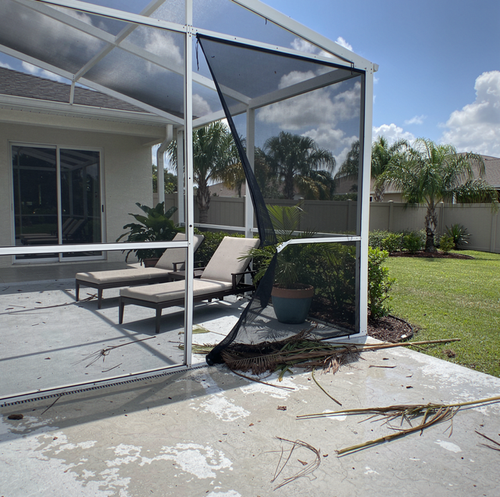
There is an order to the days after a storm takes out a pool cage screen, and the order matters more than the speed. The first hour belongs to safety and nothing else. The first day belongs to photographs, and to keeping people off a deck that may have something unstable above it. The first week is about stabilizing the opening and getting trained eyes on the frame. Run those out of sequence and three things go wrong at once: you lose the record of how the damage actually happened, you turn a contained failure into a spreading one, and you put yourself under aluminum that is no longer carrying its own weight.
Everything about the morning after pushes the other way. The pool is full of branches, torn mesh is streaming in the wind, and the instinct is to start pulling. Nearly every expensive post-storm mistake begins with that instinct, acted on before anyone looks at what is holding it all up.
Quick Answer: After a storm blows out a pool cage screen, the order is safety first, photographs second, stabilization third, assessment fourth. Repair decisions come last, once someone has looked at anchors, fasteners, and framing rather than at the mesh.
What to Check Before You Step Outside
Wait until the storm has fully passed and the area is cleared, then make the first pass through a window or slider rather than from the deck.
Start with utility conductors. Look at the service drop, at any wire crossing the yard, and at anything resting on the cage frame. A screen enclosure is a continuous assembly of aluminum members bolted together and anchored to a deck that is soaked after a storm. Aluminum carries current; the frame is one connected piece corner to corner, and standing water spreads a fault beyond the contact point.
If any wire is down near the enclosure or resting on the frame, stay inside and call the utility. An aluminum cage on a wet deck can carry current through the framing and into standing water.
Next, read the posture of the structure. Uprights leaning off vertical, a bay folded inward, roof panels lifted or missing, or the beam that ties the cage to the house pulled away from the fascia all say the same thing: this frame moved, and a frame that moved once keeps moving in ordinary wind.
Then look at the water. Broken glass, snapped limbs, screws, and brackets end up in the pool, and the water hides every one of them. There is no reason to be in that pool while something unstable is over it.
How to Document the Damage Before Anything Moves
The position of everything at rest is information. It shows which direction the load came from, which member gave way first, and how far debris traveled. Move one branch, and that is gone for good. Photographs taken before anything is moved are what an insurer and a contractor both work from later; what a policy actually covers is a question for the insurer, not for a repair crew.
Work from wide to close, from outside the enclosure perimeter. Take wide shots from three or four positions outside so the whole enclosure and its connection to the house sit in frame. Take a straight-on shot of each damaged bay, then zoom in on the failure points instead of walking in on them: a lifted base plate, a bracket missing a fastener, a bent upright. Photograph the deck and yard where fragments landed, then walk a slow video around the outside, phone held level, narrating what you see.
Keep the original files, not only the cropped versions you send to people, since the date and location data travels with the original and not always with the copy.
Photograph the sections that are still intact, not just the failures. A record of what the enclosure looked like undamaged gives both the insurer and the contractor a reference point for what the repair is putting back.
What Not to Touch, and Why Moving It Makes It Worse
A pool cage is hollow aluminum extrusions joined at the corners by brackets and self-tapping fasteners. Load travels through those joints, not the members alone, and every bay leans on the bays beside it. Screen panels are held at their edges and release there under pressure, which is why a blown panel is often intact and simply out of its frame. What matters now is that a panel hanging by one edge is loose weight swinging on a structure that may already be moving.
Do not climb the frame or lean a ladder against it: An upright is sized for its own roof and mesh, and the storm may already have taken the slack out of the anchor at its base.
Do not pull anything down from underneath: Hanging panels and displaced roof sheets come down with a crew working from the correct side, with the bay supported first.
Do not bend a member back straight: Aluminum that has yielded does not go back. Straightening the curve hides the yield and leaves a weak point the next storm finds first.
Do not prop a leaning section: A post jammed under a moving frame changes where the load goes, and a lean that was stable becomes a collapse.
Do not cut anything free: What looks like loose wreckage is often the only thing holding a bay in position, and the piece you cut is the piece that was doing the holding.
Getting the Pool and the Opening Secure
An intact enclosure lets air pass through the mesh, and that permeability is part of how the structure survives wind at all. Once the bays are open, air that used to pass through instead enters, pushes up against the roof panels from below, and loads the remaining panels harder than before. An enclosure with open bays faces more load in the next wind than it did in the storm that opened it.
What you can do without going near the damage: keep people and pets off the deck and out of the pool, and put something physical across the path so nobody wanders out there on autopilot. Leave furniture and planters where they are if reaching them means walking under a damaged bay.
What a crew does when it arrives: temporary bracing on out-of-plumb uprights, netting across open bays to keep debris and animals out, controlled removal of hanging panels, and clearing loose hardware from the pool. That work is separate from the permanent repair and happens first, since it stops the failure from spreading.
What to Look at on the Frame Itself
The mesh shows you where the failure surfaced; the frame behind it holds what happened. Load in a screen enclosure runs a path: roof panels into the beams that carry them, beams into the uprights, uprights into base plates, base plates into anchors, anchors into concrete. A storm failure travels that path, and the mesh is where it became visible.
From outside the enclosure, clear of any bay that moved, and with your eyes only, look for:
- Base plates: A plate lifted at one edge, a gap under a plate that used to sit flat, a bright ring around an anchor where it worked in its hole, or concrete cracked and crumbling around an anchor. Any of those is the anchor reporting that it took more than it was set for.
- Uprights out of plumb: Sight up each post against a true vertical, like the corner of the house. A post that is off shows against a straight edge long before it looks wrong.
- Corner brackets and fasteners: A rotated bracket, a fastener head standing proud, an empty hole, a sheared screw. A joint that opened at the top usually means something shifted at the bottom.
- The beam line: Sight along the header between uprights. It should read straight: a dip means the support under it gave ground.
- The house connection: Where the enclosure ties into the fascia or a wall, those fasteners carry a large share of everything. A gap opening along that line is structural, not cosmetic.
- Hardware that was already going: A fastener with a rust ring or chalky white powder at its head had less holding strength before the wind arrived, which is one reason a post-storm inspection looks at hardware condition and not only at what visibly broke.
What a Professional Assessment Covers
An assessment works that same load path in reverse and puts numbers on it.
Plumb and level readings are taken at every upright, not just the ones that look wrong, because a post that no longer reads true is telling you its anchor has moved. Every base plate and anchor is checked individually, along with the surrounding concrete. Members get sorted into two groups: those that flexed and returned, and those that took a permanent set, which behave differently under the next storm. The house connection and roof panel seams are inspected, and mesh tension is checked in the surviving bays. The result is a written scope with photographs attached.
That assessment also weighs which bays are handled individually and which stretches of the cage require broader work. Mesh tension in the surviving bays is part of that reading: a run that came through loose belongs in the scope with the bays that failed outright.
Where the Repair Sequence Goes From Here
The sequence is safety, photographs, stabilization, assessment, scope, repair, and every step protects the one after it. Photographs protect the record, the only version of the damage that survives once cleanup starts. Stabilization protects the rest of the structure from the next windy afternoon. The assessment protects the repair from being scoped off torn mesh, the part of a storm failure that costs the least and explains the least.
Repair after storm damage almost always arrives in two stages. The temporary stage happens quickly, because an open enclosure keeps losing ground every time the wind picks up. The permanent stage waits on the assessment and on materials, and that gap is normal, not a sign of a slow crew.
Have four things ready when the conversation starts: your original photographs, a short note on when the damage happened and what the weather was doing, what you saw from outside at the anchors and brackets, and the basics of the structure itself: attached or freestanding, the roof style, how many bays are affected, and what the deck is built from, since anchoring into concrete and into pavers use different hardware. A homeowner who can name the corner that moved first shortens the visit.
Frequently Asked Questions
Is it safe to run the pool pump after storm damage?
Not until the equipment and the water have been looked at. Leaves, pine needles, and shredded mesh get pulled into the skimmer and pump basket, and a clogged basket starves the pump; running dry is hard on the shaft seal and motor. If the equipment pad is standing in water, the motor, timer, and breaker should be checked before power is restored.
What if a tree limb is resting on the enclosure?
A limb lying on a beam is a live load rather than a fixed one. It settles as the wood dries and shifts whenever the branch it is still attached to moves. Getting it off means supporting it and cutting it in sections so weight comes off gradually rather than all at once. Tree work and enclosure repair are commonly two different crews, and the tree work goes first.
Why won't the screen door latch anymore?
A door that stops latching is reporting on the frame around it. Door openings are framed to tight tolerance, so when a section of cage racks out of square, the door is the first place it shows. Forcing the latch bends the door frame and adds a second repair. Note where the gap opened, top, bottom, or strike side, and leave the door alone.
Where does rainwater go with the roof panels gone?
Many enclosures drain through a wide gutter integrated into the beam along the house side, which collects rain off the roof panels and carries it clear of the deck. With panels missing, that path is gone, and water sheets straight onto the deck and out to its edges, where, over a few storms, it can wash the sand from under pavers or undercut a deck edge.
Does storm debris in the pool cause lasting damage?
Organic debris drives up chlorine demand and shifts pH, so water that sat with branches in it usually needs the filter cleaned and the chemistry rebalanced, not just skimmed. The larger risk is metal: hardware that ended up on plaster or a pebble finish can leave rust marks within days that outlast the storm.
How long does temporary stabilization hold?
Bracing and netting are meant to carry an enclosure for weeks, not months. Braces fasten to members that already took damage, and every windy afternoon works at them, so they want a look after each blow. Treat that stage as a hold, not the repair.
Walk your storm-damaged enclosure with a crew that repairs cages for a living — anchors, base plates, fasteners, and framing all get checked before any repair scope is set. Lanai Guy serves Brandon, Riverview, and the greater Tampa area. Call (813) 316-5971.
