



Screen Enclosure Kickplates: Who Actually Needs One?
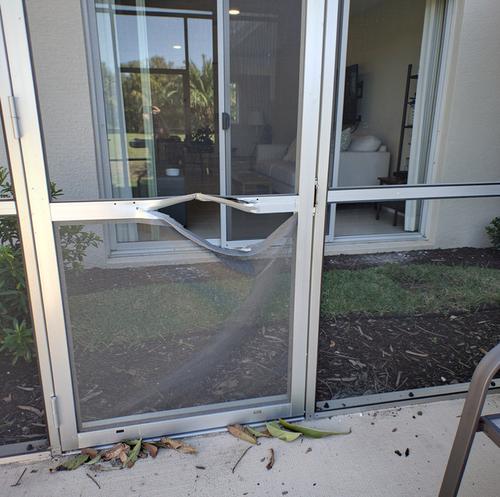
Walk the perimeter of a screen enclosure and look at where the damage actually is. A tear at knee height. A pushed-out spot behind the patio chair. A ragged edge beside the door track. Now look at the panels eight feet up. Almost always fine: original screen, still tight, no patches.
Same mesh, same spline, same age, same sun across it all. The difference is not the material.
The Damage Stops at About Knee Height
Screen is a tension membrane. It carries load spread across its whole face and has almost no resistance to a point impact, which is why a bay of standard 18-by-14 fiberglass survives years of wind and then dies to one chair leg. Six things reach the lower band of a screen bay, and essentially nothing reaches the upper one: feet, pets, furniture legs dragged rather than lifted, whatever a mower or string trimmer throws sideways, hose ends swung against the mesh, and rain splash-back that carries deck grit into the weave. The trade's answer is to stop putting screen down there.
What a Kickplate Is and How It Goes In
A kickplate is a solid panel that occupies the bottom section of a screen bay in place of mesh. Most are aluminum sheet, roughly 0.024 to 0.032 inches thick. Acrylic sheet is the other common choice. Height usually lands somewhere between a foot and two and a half feet, though that number should come from the household rather than from a catalog page.
The part people get wrong is how it attaches. A kickplate is framing work, not screen work. The installer cuts a horizontal member, a kick rail or chair rail depending on the supplier, and fastens it across the bay at the chosen height into the two vertical uprights. That rail splits one full-height bay into two: a short solid bay below, a tall screen bay above. The plate seats into the channel and is captured there; new mesh is splined in above it against the new rail.
None of that is achievable by sliding a sheet behind existing spline or screwing a plate onto the face of a panel. A plate fastened to the face still leaves the mesh behind it taking the hit, and it puts fasteners through a frame member that was never sized to carry them.
The Door and the Wall Panels Are Two Different Decisions
The door is where the case is easy. Nearly every entry ends with somebody's foot or knee against the lower part of that panel, usually because their hands are full. The door is also the only framed member in the structure that moves, so its mesh is loaded in-plane each time it swings and stops against the jamb, working even when nobody touches it. Put foot traffic on top of that cycling, and the lower section of a door takes more abuse in a month than a wall panel takes in a year. A kickplate on the door earns its place for nearly any household.
Wall panels are the optional half. Nothing pushes a wall panel except what you bring to it, so the decision turns on what happens along that run of the cage. A panel behind a row of chairs is a different proposition from a panel facing an empty side yard. Enclosures with a plate on the door and plain screen everywhere else are common and sensible, not a half-measure.
Who Lives in the House Decides Most of It
Dogs are why most kickplates get fitted, and the damage is not mainly about claws. A dog tracking something on the far side of the screen puts its chest and shoulder into the mesh, concentrating its whole push into a few square inches. Standard fiberglass does not resist that. It stretches, the spline releases at one corner, and the next push opens the mesh at the frame. Claw marks are the visible part; the shoulder push is what finishes the panel.
Measure the height a dog's front paws reach with its chest against the screen, then add four inches and give the installer that number. For a large breed, it usually lands between 18 and 30 inches.
Temperament matters more than size. A 15-pound terrier that hits the screen at a dead run does more damage than a big dog that ignores the yard. Cats are the case a plate does not solve, because they climb.
Young children reach the bottom band for the same geometric reason dogs do. They lean on it, push toys into it, and use the bottom rail as a step. In a household with both a dog and a child under about six, the wall panels stop being optional.
How the Enclosure Gets Used Decides the Rest
A lanai used as a real outdoor room, with a table, chairs, and a grill that all move, generates its own contact. Furniture legs are the quiet destroyer, because chairs get dragged rather than lifted, and a leg that catches the weave at an angle cuts rather than pushes.
Two placements make the case on their own. Where the bottom rail of a run sits against a walkway, every person on it is one stumble from the screen. Where a run meets turf, the mower and the trimmer will find it, and trimmer debris arrives at the speed of the cutting head, not the speed of the person holding it.
Mesh stops insects, not grit. Clippings, sand, and dust blow through 18-by-14 fiberglass at ground level and end up on the deck and in the water, and a solid band across the base of the run facing the yard cuts most of that off at the height it travels.
Plenty of enclosures need nothing. A cage walked through twice a week to service the pool, with no pets, no small children, and furniture that stays put, loses its bottom band to grit and sun rather than to impact, on roughly the same schedule as the rest of the screen. Solid panels buy very little there.
Pet-Resistant Mesh Is the Other Answer to the Same Problem
Heavier pet-resistant mesh addresses the same problem with a mesh decision rather than a framing one, and which grade suits a given cage is a mesh comparison rather than on this page. The distinction that matters here is that a kickplate is not a tougher version of screen; it is the absence of screen.
| Lower band of the panel | Standard mesh | Pet-resistant mesh | Kickplate |
|---|---|---|---|
| View through it | Clear | Slightly flatter | Blocked |
| Air through it | Full | Reduced | Blocked |
| Change under years of sun | Embrittles | Takes longer to embrittle | Finish chalks |
The Time to Fit One Is During a Rescreen
During a rescreen, the bay is already open. Spline is out, old mesh is off, and the uprights are bare and reachable from both faces. Cutting and fastening a kick rail into an empty bay is a short piece of work, and the mesh going back in simply gets cut to the new, shorter dimension. Nothing is thrown away that would not have come out anyway.
On an intact panel, the sequence runs backward. The mesh has to come out before the rail can go in, and it cannot go back, because the bay it was cut for no longer exists. A single kickplate on a finished enclosure means a partial rescreen of that panel plus the plate, scheduled as its own visit.
That makes this a timing question more than a product question. If a rescreen is anywhere on the horizon, settle the kickplate decision then, including for the panels you are unsure about. If the cage was rescreened recently, the case for adding plates now is weaker unless something is already failing.
What You Give Up at the Bottom of the Panel
The view is the real trade. Eighteen inches of solid material across the base of every panel changes what the enclosure looks like from a chair, from the water, and from the yard. Seated, the top edge of the plate sits close to your sightline across the deck, so it reads as a low wall inside a structure whose whole purpose is to not read as one. On the door alone, nobody notices. Around a whole cage, it is a design choice, and people take both sides.
Air at deck level is the second trade, and it is smaller than it sounds. A screen enclosure never moved much air down at the slab, but a solid band does stop the cross-draft that did pass at ankle height. Noticeable on a dead-still evening, invisible in any breeze.
Heat is the one people underestimate. Aluminum in direct sun reaches temperatures that are unpleasant against a bare leg or a dog lying along the base, and a dark finish gets there faster than a light one. Metal sheds heat up quickly once the shade arrives, which is why the complaint is always about one hour in the afternoon.
A screen panel is porous and passes some wind. A solid kickplate is not, so it hands the frame more load. Keep plates low, and have the installer confirm the uprights and anchors were sized for the added solid area.
Frequently Asked Questions
Can I put a kickplate on just the screen door and leave the rest alone?
Yes, a door-only plate is the most common single-panel option for this job. The thing to check afterward is the door's own hardware, because the plate adds weight to a panel that swings. Hinges and any closer fitted to the door often need an adjustment so it still latches without being pulled.
Will a kickplate stop a dog from pushing through the screen?
It stops the push it covers, but it creates a seam. The mesh above the plate is splined against the new kick rail, and that spline line is the closest thing to a weak point in the rebuilt panel. A dog that learns to push upward rather than straight ahead will find it, and the spline in a newly cut channel takes a few weeks of load before it seats.
What colors and finishes do kickplates come in?
Aluminum plate is normally supplied in the finishes framing already comes in, most often white, bronze, or mill, so it reads as part of the structure rather than as an addition. Acrylic is the alternative when losing light at the base matters, and it comes clear or lightly tinted, preserving the brightness at deck level that a metal plate would take away.
How long does a kickplate last compared with the screen above it?
An aluminum plate typically outlives several full rescreen cycles, so most owners fit one once and then replace the mesh above it repeatedly over the years. The parts worth a look at each rescreen are not the plate itself but the fasteners holding the kick rail and the rail's seat in the uprights.
Does a kickplate make the enclosure harder to keep clean?
It adds one horizontal ledge that was not there before. The top edge of the kick rail collects pollen, dust, and splash-back, and it holds moisture against the frame after rain, so it is where mildew shows up early and where corrosion starts at the fastener heads. Wiping that ledge when you wash the cage handles nearly all of it.
Is a kickplate the same thing as a pet door panel?
No. A pet door is a framed opening with a flap in it, built to let an animal through; a kickplate is a closed barrier built to keep an animal out of the mesh. They often occupy the same lower section of the same panel, and a plate can be cut to carry a pet door, which is worth settling before the kick rail height is set rather than after.
Ask about kickplates before your next rescreen — the bay will already be open then, so the framing work is a fraction of what a standalone fitting would require. Lanai Guy serves Brandon, Riverview, and the greater Tampa area. Call (813) 316-5971.
