



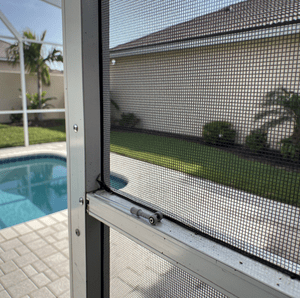
A screened pool cage stays quiet on a calm day, because nothing inside it is moving. Add wind, and every taut surface becomes something that can vibrate, while every loose or worn part becomes something that can knock, flap, or ring. Mesh under tension, the spline holding it in the frame channel, the aluminum frame itself, the hardware on a screen door, and any support cable strung across the roof can each make a sound in a stiff breeze, and the kind of sound says a good deal about which one is moving. A steady hum is a different story from a slap, a rattle, or a twang, and telling them apart before you call is what gets the right repair to the right part of the cage. This covers the sounds wind produces; a sound that continues on a calm day has a different source and a different check. Each sound comes from a different part of the cage, paired here with what is moving and whether it is a repair item:
| Sound | What Is Moving | Repair Item? |
|---|---|---|
| A low hum across a large wall or roof panel | Mesh vibrating while still under tension | No, unless it grows into a slap |
| A flapping or slapping from one panel | An edge that has gone slack | Yes |
| A rattle at a screen door | The latch, handle, or a door hanging off square | Yes |
| A ticking or knocking at a frame joint | A loose fastener or bracket at that joint | Needs an assessment |
| A high whistle at a corner | Air forced through a small gap in the frame | Needs an assessment |
| A twang or slap from a support cable | The cable itself, loose or working free | Yes |
Mesh That Hums While Still Tight
Screen mesh installed at proper tension is still a surface, and wind moving across it sets that surface vibrating at a low level. A tight panel that hums or buzzes faintly in a stiff breeze is the mesh and the wind doing exactly what they do, not a sign that anything has failed. A panel that stays flat, with no ripple or movement visible at its edges, humming this way needs no work. A larger panel, simply because it has more mesh surface moving together, can sound louder in the wind than a nearby small panel, even when both panels are equally tight, so volume by itself is not the tell. What matters is whether the panel is moving only as a whole sheet, evenly, or whether one stretch of edge is moving on its own. Screen mesh for a pool cage is woven from fiberglass or vinyl-coated polyester strands, and either material vibrates once it is pulled taut in the frame and loaded by wind. That weave is a grid of small openings across the panel, and wind passing through those openings is part of what sets the surface humming.
A Slack Panel Slapping the Frame
A hum that has become a slap, where the mesh makes contact with the frame or with its own loose edge, means one edge of that panel has come loose, from lost tension or a spline letting go, and that is a screen repair item. Looking at the panel from the house side, in an ordinary breeze, and watching for the screen moving in and out at one spot rather than staying still all over confirms a slap over a hum.
Screen Door Rattle and Loose Hardware
A screen door that rattles, bangs, or hums with each gust is loose at the latch, the handle, or a hinge, is riding a worn track, or is hanging slightly out of square with the opening it closes into. Any of those is a door-hardware adjustment rather than a mesh repair, and it is worth having checked even when the door still closes and latches fine the rest of the time, since a rattle in wind can be the first audible sign that a fastener or hinge pin has begun to work loose.
A Loose or Broken Support Cable
Some pool cage roofs carry support cables, run corner to corner or across the shorter span of a panel. Where cables are present, a cable that has lost tension makes a distinct sound: a twang, a slap against the roof panel above it, or a rhythmic tap in time with each gust. That loss of tension can trace to an end fitting that has loosened or a connection that has started to slip, and it gets re-tensioned or replaced at the point where it attaches. Support cables on a pool cage roof are stainless steel or vinyl-coated cable, anchored at each end with a swaged fitting or a turnbuckle that sets the tension. A cable that has fully snapped hangs loose and knocks against the frame in no fixed pattern, which is its own repair item rather than something to re-tension in place. The enclosure is no place to be during high winds when a panel or cable is loose.
In high wind, a loose panel or a snapped cable can fall onto anyone inside the cage, and climbing the frame or reaching a panel from a chair or the pool edge risks a fall; a crew equipped for height does that work.
A New Noise After High Wind
A sound that starts right after a hard blow is worth a closer look, since wind strong enough to loosen a cable or a fastener can also move the frame underneath it. Anything beyond a new sound, such as a leaning post or a bent frame member, gets its own assessment before any repair work starts, and a snapped cable is left alone until it is looked at.
Screen and Door Repair Work
Screen and door repair covers a slack or torn panel edge, a spline that has let go in its frame channel, a door's latch, handle, and hinge alignment, and a support cable that has lost tension or snapped outright. The loudest spot from inside the cage is not always where the loose part is; sound carries along an aluminum frame from the joint where it starts. A torn panel or a lost section of spline is re-covered and re-splined at that one opening rather than pulled into a full rescreen, so the repair stays limited to the section that failed. A bowed frame member, a leaning post, or a base that has shifted is flagged as its own job rather than folded into the repair, since that is entirely different work. An on-site estimate ahead of the work identifies which of those repairs apply to the noise you called about, so the scope is known before anyone touches a panel, door, or cable.
Frequently Asked Questions
Does mesh tension change what the hum sounds like?
It does. A panel stretched tightly produces a higher, quieter hum, since a tauter surface vibrates with smaller, faster waves. A panel that has already lost some of its tension produces a lower, buzzier tone even before it starts to slap, so a change in pitch on a panel you know well can be an early clue that tension is dropping.
Can a whistle at one corner mean something other than the mesh itself?
Sometimes. A whistle that stays fixed at a single corner, rather than shifting with the wind direction, can be traced to a small gap where a corner bracket has pulled slightly away from the frame member it joins, letting air pass over a hard edge instead of the mesh. That gap is a frame detail that needs an assessment.
Why does a loose panel slap in wind from one direction and not another?
Wind pushes inward on the panels facing it and pulls outward on the panels on the sheltered side, so a slack edge can stay quiet in wind from one direction and slap once the wind swings around and pulls it away from the frame.
Does the pitch of a cable's twang tell you anything?
Yes. A higher, ringing twang can mean the cable still holds some tension and is vibrating in a narrower range, while a duller, single thud on each gust can mean the cable has gone fully slack or slipped free of an anchor point. Either sound calls for a support cable repair.
Why can roof panels sound different from wall panels in the same wind?
Roof panels sit close to horizontal, so a gust lifts them from underneath as it moves across the roofline, producing a different flutter than a wall panel that flexes side to side. As a result, a roof panel and a wall panel can sound different in the same wind, even when both are properly tensioned.
Does a sound that stops as soon as the wind dies down mean it is not a problem?
That depends on the pattern. A sound that starts with a gust and stops the moment the gust passes tracks wind; whether it matters depends on the sound, since a hum can be normal while a slap tracks the gusts too. A sound that continues at a steady rattle or knock through a lull between gusts is different, since it comes from something already loose enough to move under its own weight rather than only under wind pressure.
Enlist screen and door repair for a slapping panel, a rattling door, or a slack support cable — re-splining, panel re-tensioning, latch and hinge adjustment, and support cable repair or replacement. Lanai Guy serves Brandon, Riverview, and the greater Tampa area. Call (813) 316-5971.