



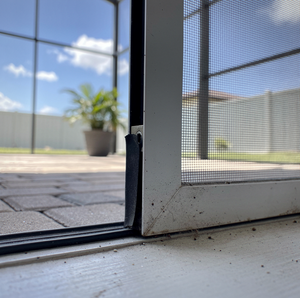
A lizard or frog inside a closed screen enclosure either came through an opening or rode in on something carried inside, such as a potted plant, and the opening is the part a repair can close. The screen fabric stretched across each bay is not an easy place for one to make one's own way through: openings appear at the edges of a bay, at the joints between framing members, and at anything built to move, such as a door, a flap, or a track. Finding where an animal got in is a different job than deciding what to do about the one already inside, and it is the job worth doing first, because the same opening lets in the next one.
Each spot on an enclosure that can open a gap is paired with what it looks like from inside and what a screen and door repair visit does about it.
| Entry Point | What It Looks Like From Inside | What the Visit Does |
|---|---|---|
| Screen door's bottom edge and latch side | A door that swings shut but leaves a gap at the corner or bottom, or a latch that does not seat | Adjusting the door so the whole edge meets the frame, then the latch |
| Bottom rail where the frame meets the slab or deck | Daylight or a draft under the rail at floor level | Found and pointed out on the visit; not closed on the spot, since sealing it would trap water on the slab |
| A torn or pulled-loose panel low on the wall | Mesh pulled free of its groove or an open tear at knee height | Re-tensioning or replacing that section of screen |
| A panel corner where the spline has let go | Mesh lifting away from the frame starting at one corner | Rolling in new spline at that corner |
| A pet door flap | A flap that hangs open, has lost its seal, or does not sit flush | Adjusting or replacing the flap and its frame |
| The joint where the enclosure meets the house wall | A hairline gap or shifted trim where the framing meets the house | Found and pointed out on the visit; work at that tie-in is a separate scope |
| A pipe, hose, or cable run through the frame | A gap around the penetration, never closed or opened as the collar shrank | Found and pointed out on the visit; not closed on the spot |
Start at the Door
Start at the door, because it is a framed part of the enclosure built to open and close every time it is used, and a door that swings shut without meeting the frame flush along its whole edge, corner to latch, leaves a gap that opens and closes with the door itself.
The Bottom Rail and the Slab Edge
A screen frame's bottom rail sits on top of the slab or deck it was built onto, fastened down but not sealed along its length. Where the slab has settled, or where the rail was set with a small gap on purpose so rainwater draining off the deck has somewhere to go, that same gap is wide enough for something small to walk through at floor level. That gap is not sealed shut on sight: sealing it solid moves the standing-water problem from outside the enclosure to inside it, so a visit notes the gap and what closing it would require without blocking the water's path.
Torn Panels and Corners Where the Spline Let Go
A torn panel low on a wall is a gap an animal can use for as long as it stays open, whatever tore it in the first place. A panel corner where the spline has let go is the same kind of opening, starting small at one corner and growing as the mesh keeps lifting away from the frame.
A Pipe, Hose, or Cable Run Through the Frame
A pipe, hose, or low-voltage cable run through the frame is a gap that was cut on purpose rather than opened by damage, which is part of why it gets overlooked. Whatever sealed that opening when it was fitted- a foam collar, a grommet, or a bead of sealant- is a separate material from the aluminum around it, and that material ages and shrinks over the years. A collar that once fit snugly around a hose or a wire can leave a ring-shaped gap years later, even if the pipe or cable itself has never moved.
Where the Enclosure Meets the House Wall
An enclosure is built up against the house and tied into the wall along one full side rather than standing free on its own frame, and that tie-in is a seam between two different materials: aluminum framing against wood, stucco, or siding. The two move at different rates as temperatures shift through the day, and a seam that was tight when it was built can open a hairline gap at that joint over time, one too fine to notice from a few feet away but wide enough at floor level or around a low fastener for something to use. The part within reach from the slab is checked by eye for a shift in the trim at either end, since a gap here shows up first as a shift in the trim rather than as a visible hole.
Where the framing ties into the house wall, the joint can run up to the roof edge, and a ladder set against a wall over a hard slab is a fall hazard; that check stays with the crew and their own ladders.
Pet Doors and Kickplate Edges
The pet door is a different kind of opening: a framed cutout with a hinged or magnetic flap sized to the pet that uses it, and that flap has to reseal itself every time it swings. A weakened magnet or weight strip, a warped flap, or a frame knocked out of square lets the flap hang open a little or swing too freely to fall back into place on its own, creating an opening the pet door was meant to close but no longer does. A kickplate, where the enclosure has one, is not the same kind of risk, since it is a solid panel rather than a moving flap; the edges worth checking there are where the plate meets the frame around it, not the plate's face.
A pet door flap that resists a light push from outside and springs back is still sealing; one that swings open under the same push or hangs off-center has lost its seal and should be replaced.
When the Gaps Are Spread Across the Enclosure
A screen and door repair visit works through the same short list: the door's fit and latch, a torn or loose panel, a spline corner, and the pet door flap, closing whichever is open rather than guessing at just one. The bottom rail, the house-wall joint, and any pipe or cable penetration are found and pointed out on the same visit, since closing those is a separate scope of work. Where the gaps are spread across several bays of the enclosure rather than sitting at one or two spots, that pattern is a different question about the condition of the screen as a whole, and it is decided separately from any single gap.
Frequently Asked Questions
Can something get through a screen panel that is not torn at all?
Not through the weave itself. The individual openings in a length of intact, properly tensioned screen are woven so fine that even a small lizard or frog cannot press a foot through one; anything that gets in past sound mesh did so somewhere the mesh ends, not through it.
How do you check a gap that isn't visible at first glance?
A flashlight held inside the enclosure at dusk and aimed low along the bottom rail and any low fastener shows a hairline gap from outside as a thin line of escaping light, a gap that daylight hides against the frame.
Does closing every gap you can see mean none will open again?
Not permanently, because aluminum framing expands and contracts with temperature through the year, and a mitered corner or a fastened joint that closed up tight on the day it was fixed can work open again by a hairline as the metal moves. That is a reason to check the same spots again later, not a sign the first repair failed.
Does propping the door open for a few minutes count as a gap?
Yes, and it is the simplest one on the list. A door held open with a wedge, a bag, or a chair leg is not a small opening at one edge; it is the full width of the doorway standing open for as long as it stays that way, and closing every other gap on the enclosure does nothing while the door itself is propped.
Can a lizard or small frog fit through an opening that looks too small to matter?
Yes. Both a lizard and a frog can flatten and compress their bodies to pass through an opening narrower than their resting width, so a gap that looks too tight to be the culprit should not be ruled out on size alone.
Does an animal getting in leave a mark on the gap it used?
A lizard or frog passing through an existing gap leaves little or no trace; a stretched or torn edge at that spot was widened by something else first, and the animal only found it afterward.
Commission screen and door repair — the work covers a door that no longer latches tight, a torn low panel, a panel corner where the spline let go, and a pet door flap that hangs open. Lanai Guy serves Brandon, Riverview, and the greater Tampa area. Call (813) 316-5971.