



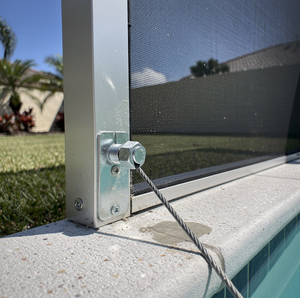
A screen-roof pool cage is a set of aluminum posts and beams joined at bolted connections, and each joint can turn slightly under load. Wind pressing on the walls and dragging across the screened top tries to push the whole frame sideways, so the posts tip together and the rectangles between them lean out of square. Hurricane cables resist that lean: steel cables run from the upper frame down to anchors fastened in the deck, and once they are tensioned, a frame that starts to tip has to stretch them first. Adding cables to a cage that never had them, or to one whose original cables are corroded, slack, or broken, depends first on whether the frame and deck can support them, and only then on running and tensioning the cable itself.
Each readiness check comes with what gets looked at and the finding that changes the plan:
| Readiness Check | What Is Looked At | What Changes the Plan |
|---|---|---|
| Is the cage plumb and square? | Every post checked for vertical, and every bay opening checked for a lean | A lean calls for straightening the frame before any cable is tensioned |
| Frame members and their connections | Beams, posts, and the bolts and brackets at each joint | Bent or corroded members and failed fasteners are replaced first |
| The deck at each anchor point | The concrete where each cable will land | A cracked or crumbling spot moves the anchor to sound concrete |
| Existing cables, brackets and anchors | Rust on the cable and its fittings, lost tension, broken runs, anchors that have backed out | A damaged cable is replaced, not re-tensioned |
| The screen roof | The age and condition of the roof panels | A rescreen that is due puts the cable work on the same job |
How a Screen-Roof Frame Leans Without Cables
The joints in an aluminum cage are bolted or screwed through brackets and through the members themselves. That kind of connection holds the parts together and carries weight down the posts, but it offers limited resistance to rotation, so a bay made of four members joined at four corners can shift out of square when pushed sideways at the top. One bay leaning a fraction does not look like much. Across a whole wall, the same small rotation at every joint adds up, and the beam line at the top ends up offset from the wall's base.
Wind reaches the cage as pressure on the walls and drag on the roof panels, and all of it arrives at the top of the posts as a sideways push. Each post takes that push at its top, anchored at its base with nothing holding it sideways above the base plate.
Other parts of the structure share the load. Where the cage fastens to the house along a beam at the roofline, that connection holds the house side in place, and on some cages short angled braces stiffen the corners. Hurricane cables add a direct path: a cable from the top of the frame to a deck anchor turns the sideways push into tension in the cable and a pull on the anchor, so the frame cannot drift without stretching steel. A cage that has lost that path, or never had it, leans further in the same wind, and each cycle of leaning and returning can work the joints looser.
Straightening a Cage That Has Already Racked
A cable holds the frame in whatever position it occupies when the cable is tensioned. On a cage that is already leaning, tensioning cables first would lock the lean in place, and the out-of-square bays would stay that way with the cables now resisting any move back. So, a racked frame is first brought back to plumb, with the posts drawn upright and the bays squared, and the cables are then set to hold that corrected position.
A lean can come from joints that have loosened, from base-plate anchors that have shifted, or from a member that has bent. Loosened joints are tightened or refastened as the frame comes back. A member that has bent, cracked at a connection, or corroded through is a different case: aluminum that has taken a permanent bend stays bent, so that member gets replaced, and the job becomes a structural repair that includes cables.
A frame that holds plumb once drawn back is ready for cables. One that drifts toward its old lean still has a loose or damaged connection or a shifted base anchor that needs attention before any cable goes on.
Until that work is done, a cage that is visibly leaning, has a snapped cable, or has an anchor pulled out of the deck is no place for people to be in high wind. None of the readiness checks call for climbing the frame or standing on the roof beams either; the beams carry screen and their own weight, and they are not a walking surface.
Anchors and the Deck They Go Into
Each cable ends at an anchor fastened into the deck, and the anchor holds no better than the concrete around it. A concrete screw anchor or an expansion anchor holds by gripping the walls of its hole, so the concrete there has to be solid, uncracked, and thick enough to take the pull. Where the slab is cracked, spalled, or crumbling at the edge, the anchor point is moved to sound concrete nearby, and the cable angle is adjusted accordingly.
Distance from the slab edge matters for the same reason. Concrete close to an edge has less material behind the anchor, and a hard pull toward that edge can break a wedge of concrete away. Plumbing for the pool pump and filter can also run under the deck, which is one reason drilling for anchors is left to the crew rather than attempted by a homeowner.
Existing anchors on an older cage get checked for rust at the head and for any that have backed out of the concrete. Loosened fasteners are re-secured, and corroded ones are replaced. Pavers laid over a slab, or over sand with no slab under them, raise their own anchoring question.
Running and Tensioning the Cables
With the frame plumb and the anchor points settled, each cable is attached high on the frame, run down to its deck anchor, and drawn tight. Tension in a cable takes up the slack, so it starts resisting the moment the frame begins to move and pulls on the frame where its upper end is fastened.
Even tension across the set pulls the frame into line and holds it there. Over-tightening one run drags the top of that post toward its anchor, and the frame can end up leaning the other way, out of plumb in a new direction. Tension is balanced across the cables with the frame's plumb rechecked as it comes up, so no single cable is cranked hard to correct a lean the others are not sharing. The finished state is a set of cables all taut, with a frame standing straight between them, with no cable left slack and none pulled hard enough to bow the member it attaches to.
A tensioned cable stores energy, and one that is cut, unclipped, or released at its anchor can whip across the deck with enough force to injure anyone standing nearby; loosening, tightening, or cutting a cable is work for the enclosure crew alone.
Timing the Retrofit with a Rescreen
A cable retrofit can be done on its own with the screen left in place, or folded into a full rescreen of the cage. When the old screen comes off for a rescreen, every bay is open, and every joint is exposed, so the straightening and anchor work can go ahead without working around panels. Squaring a frame with screen still in it can pull panels loose at the spline or distort their tension, because each opening changes shape as the frame moves.
In a combined job, the framework comes first, then the new screen, and the cables are tensioned at the very end so the screen work and the cable work stay out of each other's way. A rescreen that is due anyway is a reason to plan the cables with it. A roof whose screen is still sound and supple does not need to be removed solely for cables.
Who Decides the Cable Layout
The number of cables a cage carries, which bays they run in, what they attach to at the top, and what kind of anchor holds them at the deck are engineering questions. On a screen-roof cage, cables are part of how the structure was engineered to stand, and a retrofit follows engineering that fits that particular frame: its height, its spans, its roof shape, and whether it ties into the house. Two cages of different sizes or roof styles need not share one layout.
Original permit drawings or engineering sheets for the cage, if a copy survives in the home's paperwork, can show where cable positions were first planned, giving the retrofit layout a reference to check against.
Whether a retrofit requires a permit is determined by the local building department, and the answer may depend on what else the job includes, such as replacing frame members alongside the cables.
Frequently Asked Questions
How can you tell whether an older cage ever had cables?
Leftover hardware gives it away. An eye bolt or small bracket near the top of a post with nothing attached, or a plate or a pair of drilled holes in the deck a short distance out from a post base, marks where a cable once ran. A cage with no hardware at either end and no holes in the deck shows no sign of ever having carried them.
Why are cables set in opposing positions across a cage?
A cable resists only when it is pulled. When the frame leans away from a cable's anchor, that cable goes tight and holds; when the frame leans toward the anchor, the same cable goes slack and does nothing. Bracing both directions of lean takes a cable positioned to go tight in each case, which is why cables appear on opposite sides.
Why does a cable run at an angle instead of straight down a post?
A cable running parallel to a post stays nearly the same length as the post's tips, so it offers no pull-back against the lean. Running the cable from high on one post to an anchor out along the deck gives it horizontal reach, and that reach is what lets it pull the top of the frame back toward plumb.
What holds a cable at each end?
At each end, the cable is bent into a loop around a thimble, a grooved metal insert that prevents kinking at tight bends, and the loop is clamped with wire-rope clips or a pressed sleeve. With clips, the U-bolt sits on the short tail and the saddle on the loaded length, since a clip fitted the other way round crushes the working part of the cable.
Does galvanized cable age differently from stainless steel cable?
Yes. Galvanized cable is steel with a zinc coating, and the zinc corrodes first, sacrificing itself to protect the steel beneath. Once that coating is used up, the steel rusts, and brown staining appears on the strands. Stainless cable resists corrosion without a coating, although it can still pick up surface staining.
What happens to an anchor hole that is no longer used?
A hole that an anchor has worked loose in can be enlarged, and where it is, a new anchor of the same size has too little concrete left to grip, so the replacement goes into fresh concrete clear of the old hole. An open hole left in a deck collects water and debris, and filling it closes that off.
Arrange a hurricane cable retrofit on your existing pool cage — a plumb check of the frame, anchors set in sound deck, and cables run and tensioned. Lanai Guy serves Brandon, Riverview, and the greater Tampa area. Call (813) 316-5971.